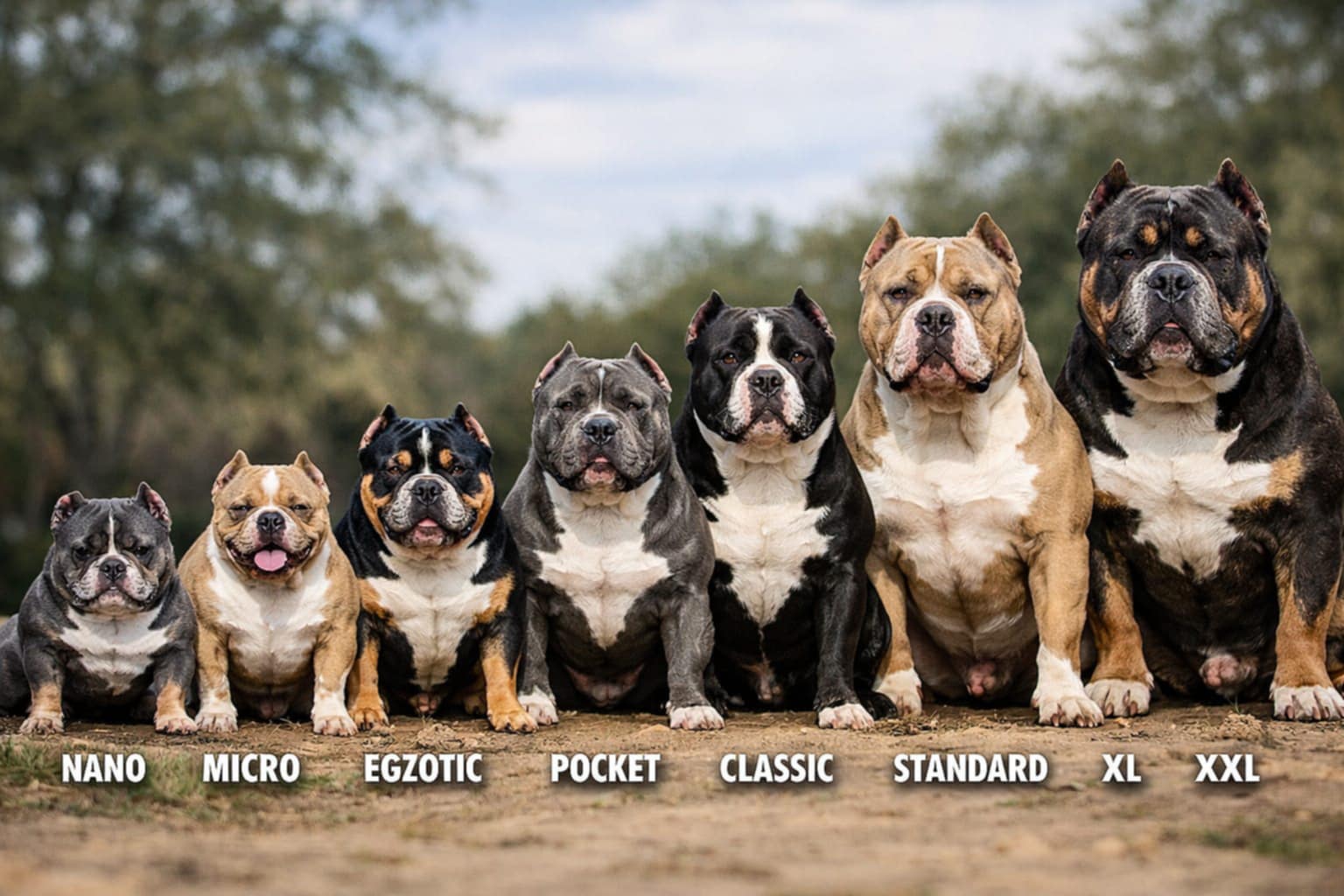
FEATURES AND STANDARDS
AMERICAN BULLY BREED STANDARD
The American Bully should give the impression of being extremely strong for its size. It is a compact, medium-sized dog with a muscular build, heavy bone and a large, expressive head.
Character and temperament
- Companion breed: confident, cheerful, eager to cooperate and obedient.
- Family companion: usually gentle, does well at home and around children.
- Stability: aggression or extreme shyness are atypical and highly undesirable.
- Overall impression: a “powerful look” without losing a balanced disposition.
Size varieties
- Pocket: smaller version of the standard type while maintaining proportions. Males 36–43 cm, females 33–41 cm.
- Standard: classic breed structure, harmonious proportions and “Bully” type. Males 43–51 cm, females 41–48 cm.
- Classic: similar height to Standard, but lighter frame. Males 43–51 cm, females 41–48 cm.
- XL: larger size, mass while maintaining harmony of structure. Males 51–57 cm, females 48–54 cm.
- XXL: dogs taller and more massive than XL (term used in practice).
Structure — key points of the standard
Head
- Heavy, large and broad — clearly “Bully”.
- Medium length, deep, with a broad skull and strong cheek muscles.
- Stop distinct and deep.
Ears
- Set high, may be natural or cropped (depending on show/organization regulations).
Eyes
- All colors allowed except albinism (disqualification).
- Oval or almond-shaped, set low and wide apart.
- Blue eyes and lack of pigment around the eyes — undesirable.
- Visibility of the sclera should be minimal.
Muzzle and bite
- Muzzle short to medium, broad — shorter than the skull, but not so short as to impair breathing.
- Topline of muzzle straight; nose neither pointed nor upturned.
- Lips semi-closed, even (slight looseness acceptable but not preferred).
- Bite: scissors. Faults: level, undershot, overshot, crooked.
- Nose: large with wide open nostrils; all pigmentations allowed.
Neck
- Heavy, muscular, slightly arched, tapering toward the back of the skull.
- Minimal loose skin or none.
Front (forequarters)
- Shoulder blades broad and muscular, well laid back.
- Forelegs straight and strong; pasterns short and almost upright.
- Feet pointing straight forward; stance too narrow / feet turned in or out — undesirable.
Body
- Heavily muscled, massive, compact — “very strong for size”.
- Chest deep and broad, but without excess that restricts movement.
- Ribs well rounded (“barrel”), close together.
Back and proportion
- Back short to medium-short — slightly sloping from withers to croup or straight.
- “Square” impression: body length close to height.
Rear (hindquarters)
- Well muscled, proportional to the front.
- Viewed from behind — straight and parallel.
- Croup slightly downward; hocks not turned in or out.
Tail
- Medium size, set low, tapering toward the end, reaching approximately to the hock.
- Carried low at rest; in motion level with back or higher (excitement), but not curled over the back.
- No kinks, knots or curves.
Feet
- Round, compact, medium size in proportion to the dog, well-arched toes.
Coat
- Short, dense, glossy, stiff or smooth to the touch.
- Coat length up to approx. 1.27 cm.
Color and pattern
- All colors and patterns are permitted.
Movement (gait)
- Confident, proud, energetic; movement free and springy.
- Strong rear drive, moderate reach in front — harmonious.
- Legs should not cross or drift inward/outward; topline stable.
Faults, serious faults and disqualifications
Faults (penalized but without disqualification)
- Excessive haw
- Bulging eyes
- Muzzle too long or pointed
- Lack of distinct / deep stop
- Weak lower jaw
- Raised lower jaw
- Albino nose (light pink)
- Upturned nose or pushed back
- Tail too long or too short (approx. 2.5 cm from the hock)
- Curled tail (gay tail)
- Level / even bite
- Undershot or overshot bite
- Crooked or cross bite
- Neck too thin or weak
- Neck too short or too long
- Straight shoulders; steep and forward-set scapula
- Upper arm too short
- Severe turned fronts (inward or outward)
- Curved front legs
- Weak pasterns
- Splayed or flat feet
- Long toes
- Hocks turned inward or outward
- Curly or wavy coat
- Gait: rolling, sidewinding, hackney, paddling or pounding
- Not moving in the same plane (crossing over, rear too close)
Serious faults (heavily penalized but without disqualification)
- Significant undershot or overshot (0.6 cm / 1/4 inch or more)
- Broken tail
- Twisted tail
- Kinked tail
- Fused tail
- Tail too short
- Long coat / long hair (long coat)
Disqualifications
- Displaying aggressive behavior toward humans
- Pink or albino eyes
- Unilateral or bilateral cryptorchidism (missing one or both testicles)
- Unilateral or bilateral deafness
- Screw tail
- Short tail
- Docked tail
Exotic Bully breed standards
The Exotic Bully is lower and more compact for its size, with a rounded yet characteristic silhouette and a square head. It should move freely, be active and alert to its surroundings.
Size categories
- Micro Exotic — males up to 34 cm, females up to 32 cm
- Pocket Exotic — males above 35 cm, females above 33 cm
Head
- Medium length, broad skull, very pronounced cheek muscles, distinct stop.
- Ears set high.
- Excessive wrinkles are undesirable, but are not a fault or disqualification.
Ears
- Natural “drop”, “rose” or cropped.
Eyes
- Oval or slightly round, set wide apart.
- Any color permitted except albinism.
- Unusual color (e.g., one dark, one light/blue) — not preferred.
- Lack of pigment around the eyes — undesirable.
Muzzle (muzzle) and bite
- Desired short, angular muzzle with a square shape.
- Clearly defined jaws; the lower jaw must be strong.
- Lips semi-closed and even; slight looseness acceptable but not preferred.
- Nose — all colors accepted.
Neck
- Heavy, slightly arched, tapering from shoulders to the back of the skull.
- Compact build, minimal or no loose skin.
Back and topline
- Strong and muscular; shoulder blades set wide apart.
- Back fairly short; slight slope from withers to croup or straight line permitted.
- Gentle, short slope from croup to tail set.
Body
- Well-sprung ribs, deep in the rear portion, ribs close together.
- Chest deep and broad.
Tail
- Preferred long or medium length, set low, tapering toward the end.
- Long tails past the hocks, kinks and knots — serious faults.
Limbs
- Strong bone; front legs may be slightly bowed.
- Vertical pasterns preferred.
- Feet medium size, well-arched and compact.
- Hindquarters well defined.
Gait
- Light and energetic, free.
- Strong rear drive; in movement the dog maintains a straight topline.
Coat (coat)
- Short, close, soft to the touch, with a glossy appearance.
Color and pattern
- All colors and patterns are accepted.
Size and weight
- Height and weight should be proportional to the dog’s structure.
- No strict weight limit — a harmonious silhouette matters most.
Disqualifications
- Displaying aggressive behavior toward humans and other dogs
- Cryptorchidism (missing one or both testicles)
- Unilateral or bilateral deafness
- Severe anatomical deformities
Support Our Work
If you would like to support the development of American Bully Polska, you can help us with a donation. Every contribution helps us organize events, provide education, and build a safe and responsible community.
- Bank: PKO BP
- Account Number: PL 96 1020 2498 0000 8102 0884 9509
- SWIFT / BIC Code: BPKOPLPW
- BLIK Transfer: 570 989 144
In the transfer title you may write: Donation
Thank you for your support ❤️